
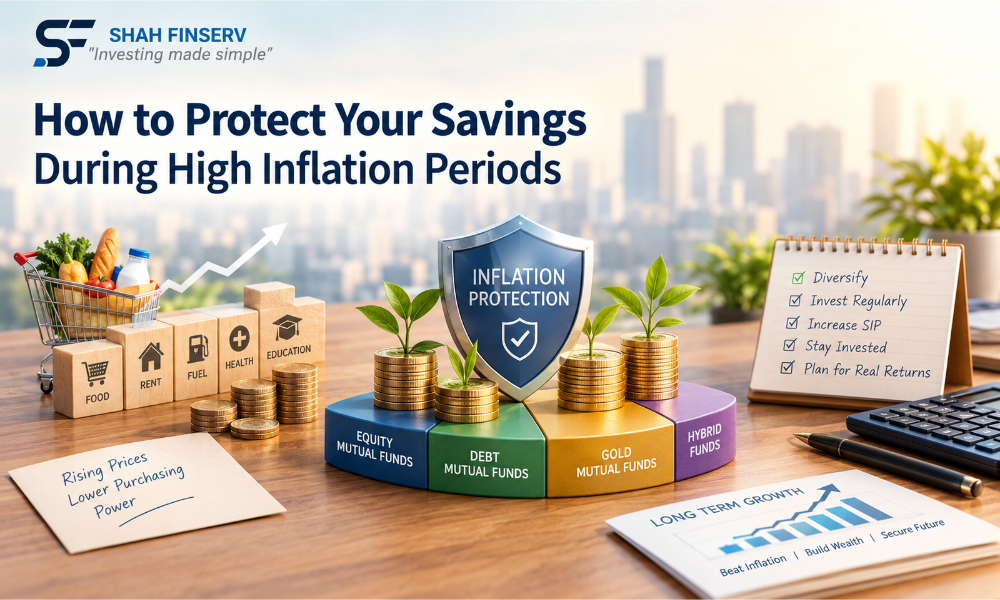
When prices rise faster than usual, the money in your bank account quietly buys less each year. Groceries, school fees, medical bills and fuel all cost more, while your savings stay the same number on a statement. That is why many investors start looking for inflation-proof investments during periods of high inflation.
This guide explains how inflation affects your money, which investments have historically helped savers stay ahead of it, and how mutual funds can fit into a practical plan.
Why High Inflation Hurts Your Savings
Inflation reduces what each rupee can buy. If your savings earn less than the rate of inflation, your real return, meaning the return after accounting for rising prices, is negative. You have more money on paper but less purchasing power in reality.
For example, if inflation is 6% and your savings earn 4% before tax, you are effectively losing about 2% of your buying power every year. The effect compounds quietly over time.
The table below is illustrative and shows what ₹1,00,000 worth of expenses today could cost in 10 years at different inflation rates.
|
Average inflation rate |
Cost in 10 years |
|
5% |
About ₹1.63 lakh |
|
6% |
About ₹1.79 lakh |
|
7% |
About ₹1.97 lakh |
In other words, money that is not growing needs to nearly double in a decade just to keep up with a 7% inflation rate. For a deeper look at the effect on your savings, read our article on how inflation impacts your savings.
Is Any Investment Truly Inflation-Proof?
Honestly, no investment is completely inflation-proof. Every asset carries some risk, and returns are never guaranteed. What investors can do is choose assets that have historically had a good chance of beating inflation over the long term, and combine them sensibly.
The goal is not to avoid inflation entirely. It is to earn a return above inflation, after tax, over your time horizon.
Investment Options That Can Help Beat Inflation
Equity mutual funds. Over long periods, equities have historically tended to grow faster than inflation because company earnings and prices tend to rise with the economy. The trade-off is volatility. Equity funds can fall sharply in the short term, so they suit money you will not need for five years or more.
Gold. Gold often holds its value when prices rise and uncertainty grows, which is why many people use it as a hedge. It does not produce income, and its returns can be uneven, so it works best as a smaller part of the portfolio. You can compare the two in our guide on gold vs mutual funds.
Debt and short-duration funds. These add stability and can help your money earn more than a typical savings account. In some years their returns may only match inflation, so they are better for stability and near-term goals than for long-term growth.
Hybrid funds. These hold a mix of equity and debt in one fund. They can suit investors who want some inflation-beating growth with less volatility than a pure equity fund.
Fixed deposits and traditional savings. These offer safety and predictable interest, but the interest is taxable. After tax, the real return can fall below inflation, especially for investors in higher tax slabs.
A Mutual Fund Approach to Protecting Your Savings
A practical plan does not depend on picking one perfect investment. It combines a few simple habits:
-
Spread money across asset classes. Hold a mix of equity, debt and gold so that no single asset decides the outcome.
-
Invest regularly through SIPs. A monthly SIP builds wealth gradually and removes the pressure of timing the market. Our guide on SIP vs lump sum investment explains when each approach works.
-
Increase your SIP every year. If your income rises, raise your SIP too. Even a modest annual increase can help your investments keep up with rising costs.
-
Match investments to timelines. Keep short-term money in stable options and long-term goals in growth-oriented funds.
-
Stay invested. Frequent switching in reaction to headlines often hurts returns. Our article on investment planning during market volatility covers how to stay disciplined.
Practical Steps for High-Inflation Periods
-
Review your budget. Identify which costs are rising fastest and where you can trim.
-
Keep a right-sized emergency fund. Hold enough for emergencies, but avoid parking large amounts in low-return accounts. See how much to keep in our guide to emergency fund planning.
-
Pay off costly debt. Credit card and personal loan interest can outpace any investment return.
-
Revisit your insurance cover. A cover that was enough five years ago may fall short today, so check whether it still matches your family's needs.
-
Think in real returns. When comparing options, ask what you will earn after inflation and tax, not just the headline rate.
Mistakes to Avoid During High Inflation
-
Keeping too much in a savings account where interest rarely keeps pace with prices.
-
Chasing last year's top performer without checking risk or time horizon.
-
Putting everything into gold or property because it feels safe.
-
Stopping your SIP when markets look uncertain, which is often when disciplined investing matters most.
-
Expecting guaranteed protection. No product removes inflation risk completely.
Protect Your Savings With a Plan That Fits You
Protecting your savings from inflation works best when your investments are matched to your goals and risk comfort. At Shah Finserv, we help families and business owners across Vapi, Valsad and nearby areas build mutual fund portfolios designed to grow over the long term. Explore our mutual fund services, or contact us to plan your next step.
Related Blogs

-
November 21, 2026

Mutual Funds for Beginners: How to Start Investing in India
We Deals In


Frequently Asked Questions
This term usually refers to assets that have historically had a good chance of growing faster than inflation over the long term, such as equity funds and gold. No investment is entirely inflation-proof, because returns and risks always vary.
Equity funds have historically had the strongest potential over long periods, while hybrid funds balance growth and stability. Debt funds help with stability and near-term goals. The right mix depends on your goals, time horizon and risk comfort.
Gold can help protect purchasing power when prices rise and markets feel uncertain, but it earns no income and its returns can be uneven. Most investors hold it as a smaller part of a diversified portfolio.
No. Continuing your SIP is usually more sensible, since stopping means your money stops working just when its purchasing power is under pressure. Review your plan, but avoid reacting to headlines.
There is no fixed answer. It depends on your age, goals, income stability and how long you can stay invested. A financial advisor can help you decide an allocation you can follow comfortably.